

1.9 Axle Groups
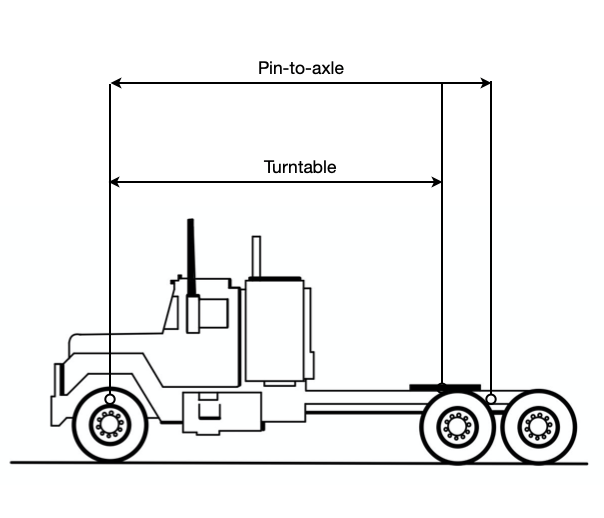
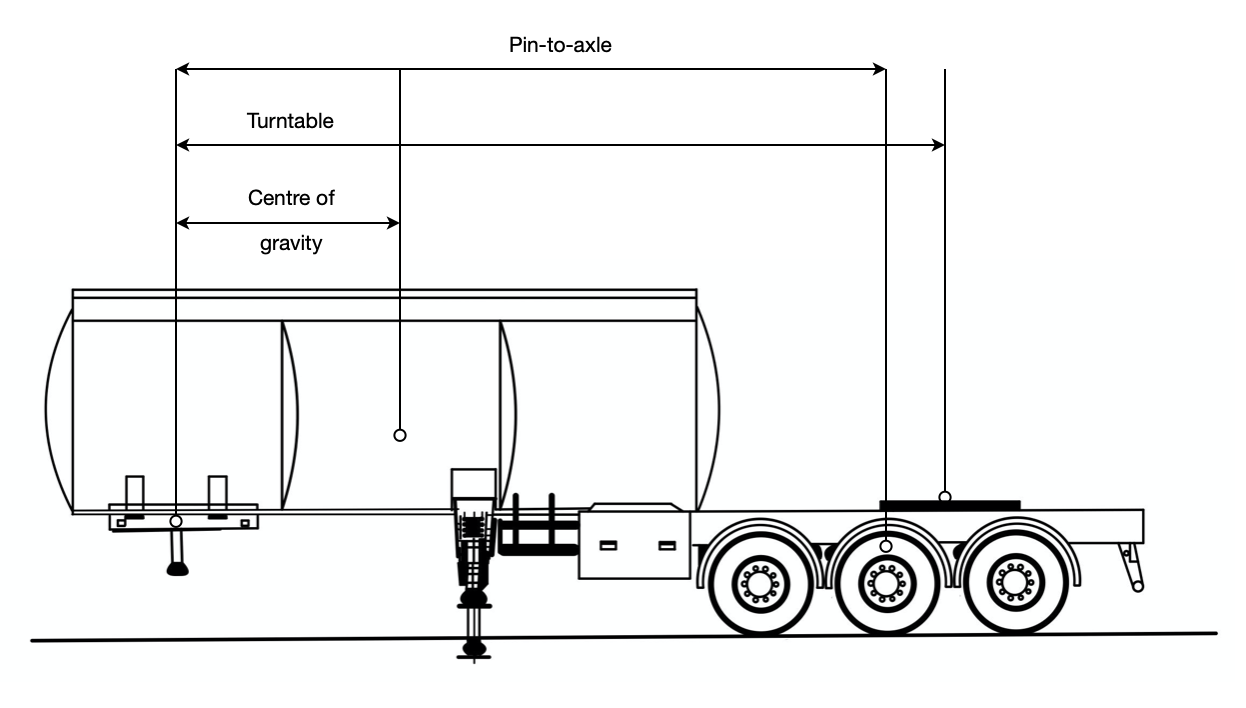
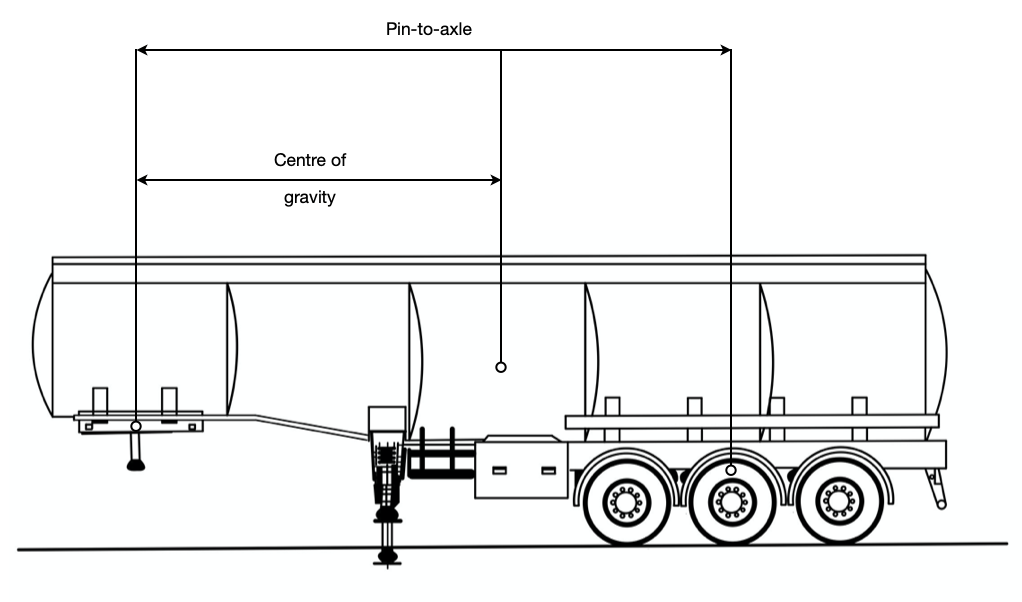
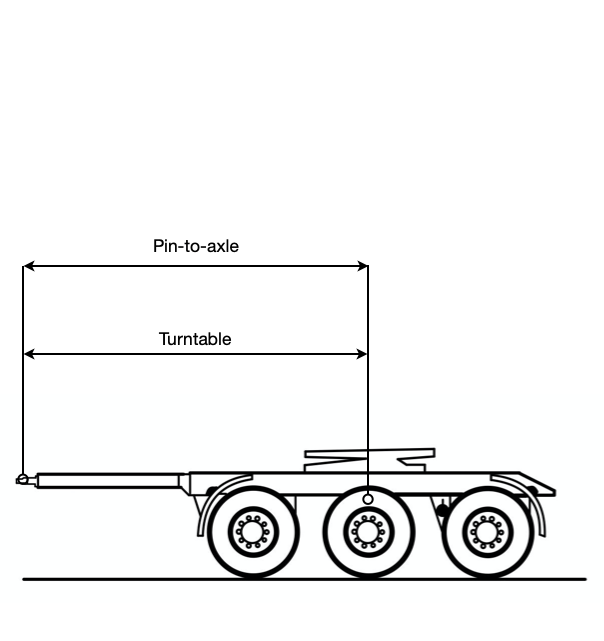
The vehicle is described in terms of its axle groups and its compartments. Each axle group corresponds to a semi-trailer or dolly. An axle group has one set of wheels, and hooks into the preceding axle group through either a fifth-wheel coupling (turntable) or a drawbar (in a dolly). A prime mover is modelled as if it were a dolly followed by a semi-trailer. Figure 1 shows an example of these.
For each axle group, we define:
- Pin-to-axle
The distance between the kingpin and the centre of the axle group. In case of a dolly, this would notionally be the distance between the front of the drawbar and the centre of the axle group, but because the length of the drawbar has no material effect on the load build, we can use a notional value of, for example, one metre. - Has Turntable
Whether the axle group has a turntable? - Turntable
The position of the turntable (if applicable) as measured from the kingpin. If this is less than the pin-to-axle distance, then it means that the turntable is in front of the centre of the axle group, otherwise it is behind it. - Pin Tare
The tare weight of the trailer/dolly as measured under the kingpin. - Axle Tare
The tare weight of the trailer/dolly as measured under the axle group (i.e. under the wheels).
Example Axle groups for a B-double:
The first two axle groups are on the prime mover: Steer is the front wheels and Drive is the rear wheel set. The front of the prime mover weighs 4,096 kg and the rear weighs 5,475 kg. The distance between the front and rear wheels is 4,800 mm (we have chosen millimetres as the unit of distance here). The turntable on the prime mover is positioned 4,450 mm from the front wheels (i.e. it is 350 mm in front of the centre of the rear wheel set). Note that the front wheels are essentially a dolly. We set a notional pin-to-axle and turntable position right above the axle group.
The first trailer, T1, has a pin-to-axle distance of 7,950 mm and a turntable that is 300 mm behind the centre of the axle group (at 8,250 mm from the kingpin). The tare weights under the kingpin and wheels are 1,650 kg and 4,450 kg respectively.
The second trailer, T2, has a pin-to-axle distance of 7,850 mm and has no turntable. The tare weights under the kingpin and wheels are respectively 1,300 kg and 4,950 kg.
Example Axle groups for a rigid vehicle:
We model rigid vehicles as a trailer hooked directly to the front axle group. The distance between the front and rear wheels is 5,087 mm. The tare weight under the front wheels is 7,590 kg and the tare weight under the rear wheels is 5,470 kg.
Example Axle groups for a rigid vehicle with a dog trailer:
We model dog trailers as a trailer hooked directly to a notional dolly. This dolly corresponds to the front axle group of the trailer. The distance between the trailer’s front and rear axle wheels is 8,071 mm. The tare weight under the trailer’s front wheels is 2,660 kg and the tare weight under its rear wheels is 5,470 kg.
The OLM supports arbitrary vehicle configurations, from single-trailer vehicles through to road trains.