

1.13 Weight Calculation
In this section, we describe how the optimiser calculates the weights on each axle group for a given vehicle configuration and allocation. Table 10 shows a sample allocation to the B-double from Table 4, whose compartments are shown in Table 7. We use this as a running example.
We begin by calculating the weight for each compartment. This is calculated using the following formula:

where c is a compartment, and p the product in that compartment. For example, the first compartment in Table 10 contains 8,340 L of Diesel. This will have compartment weight of 8,340 L ⋅ 0.85 kg∕L = 7,089 kg. The sixth column of Table 10 shows the calculated weights for each compartment in the example.
Next, for each axle group, we calculate a pin weight and an axle weight. For axle groups that do not include a turntable, the formulas to do this are:


That is, the pin/axle weight is the pin/axle tare, plus a proportion of the compartment weights on the axle group based on how far the centre of gravity of the compartment is from the pin/axle. For example, considering the rear trailer (T2) of the B-double and allocations given from Table 10. The pin weight equals
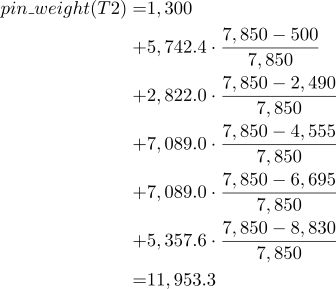
and the axle weight equals
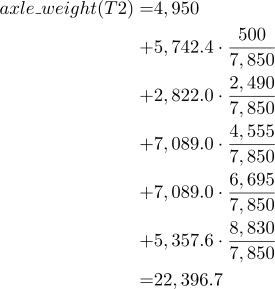
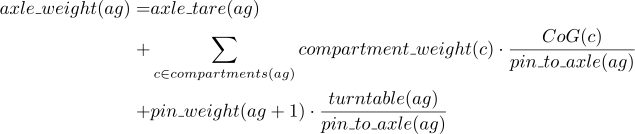
For axle groups that do have a turntable, we also need to add the weight of the next axle group’s pin weight to the formula:

For example, for the front trailer (T1) of the B-double and allocations as before, the pin weight equals
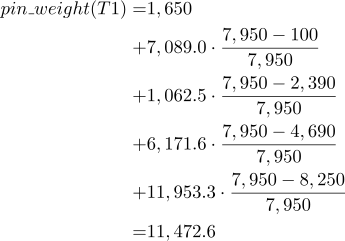
and the axle weight equals
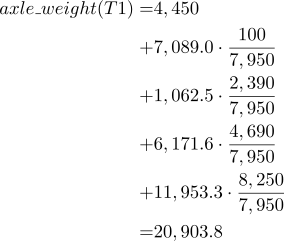
The drive and steer axle groups on the prime mover, as well as any dollies, function similarly, except that they do not have any compartments.




Table 11 lists all of the axle weights as we have calculated them, together with the GCM. The GCM is the sum of all of the axle weights.